
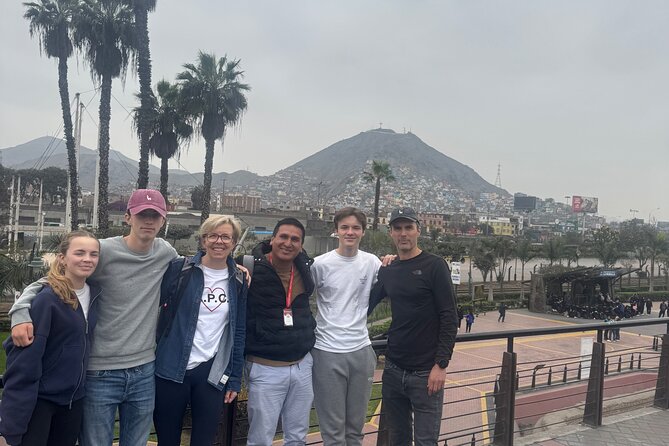
Reviewed · WALKING TOURS
Enjoy Lima Walking Historic Center San Martin and Plaza Mayor
Lima’s Historic Center is one of those places you understand faster on foot than from any bus window. This 2-hour walk strings together the big squares and major churches so the city’s story makes sense, street by street. I especially like the Plaza Mayor focus and how smoothly it connects the colonial core to Lima’s independence era through architecture and monuments.
I also like the guide-led storytelling in a small group, with names like Gabriel and Alvaro showing up in standout reviews for patience, good anecdotes, and time for photos. The optional pisco tasting is a fun final nudge if you want a local taste to go with the history. One possible drawback: it is still a walking tour, so plan for steady pavement time and bring shoes that can handle it.
Key points at a glance
- Plaza San Martín’s independence statue and elegant historic buildings set the tone fast
- Jirón de la Unión links two major squares and keeps the walk lively with shops and street life
- La Merced’s Baroque church details include carved stone and golden altarpieces, tied to Lima’s early Mass
- Plaza Mayor, Lima Cathedral, and the Government Palace area gives you the political heart of the city in one sweep
- San Francisco’s convent and catacombs area adds a darker, fascinating viceroyal-era layer
- Parque de la Muralla views by the Rimac River give you a breather plus photo angles toward Cerro San Cristobal
Start Where Lima Looks Classic: Gran Hotel Bolívar to Plaza San Martín
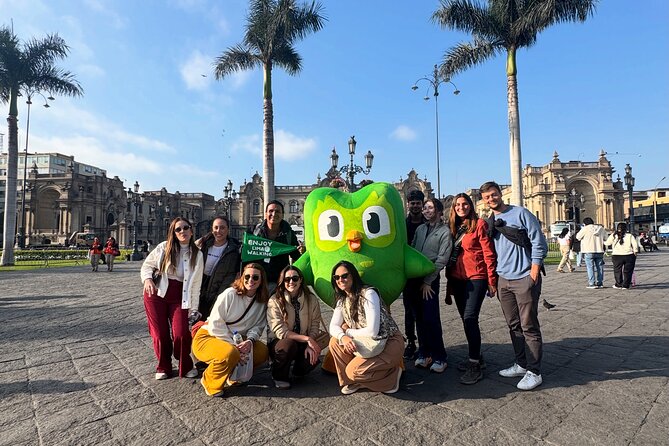
Most walking tours in Lima ask you to meet somewhere central, then rush you into the next landmark. This one begins near the Gran Hotel Bolívar, which is a good start for two reasons. First, it puts you right where Lima’s historic core begins to feel dense and architectural. Second, it sets up an easy “walk to learn” rhythm instead of hopping around.
You’ll be with an official tourism guide, and the group size stays small, up to 20 people. That matters. With a smaller group, it is easier to ask questions, get directions to the right details, and stop for pictures without feeling like you’re being herded.
And yes, you will walk enough to stay awake and interested. The tour clocks in around 2 hours, with short stops that build to the big payoff at Plaza Mayor.
More Historical Tours in Lima
- Discover Lima: Love Park, Historic Center, and its Catacombs.
★ 5.0 · 696 reviews - Street Food, Market & Old Eateries Tour in Lima’s Historic Center
★ 5.0 · 656 reviews - Lima’s lively Heritage: Exploring the City’s Landmarks Half-day
★ 4.5 · 581 reviews
Plaza San Martín: 1921 Independence Pride in a Neoclassical-At-Art Nouveau World
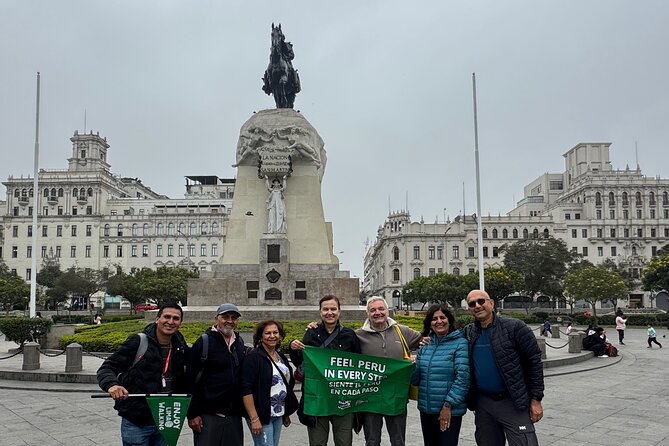
Plaza San Martín is one of Lima’s signature squares, and it works as a warm-up like no other. Opened in 1921 for the centenary of independence, it anchors the conversation about Peru’s break from colonial rule. Look for the statue of Don José de San Martín, then let your eyes travel outward to the buildings framing the square.
What I like here is the contrast between styles and eras. The plaza is described with a mix of neoclassical and Art Nouveau character, so you get a visual reminder that Lima did not freeze in 1535 and call it a day. It kept growing, refurbishing, and reinventing itself.
You’ll also notice how this square connects to the next step of the walk. The goal is not just to look at a monument. It is to understand why this part of the city became the stage for power, ceremony, and later independence messaging.
Jirón de la Unión: The Most Famous Pedestrian Street for 400 Years of Lima
Right from Plaza San Martín, you transition into Jirón de la Unión, often described as Lima’s emblematic connecting street between key squares. It is pedestrian, so it feels less like traffic and more like strolling through a living corridor of the historic center.
This is where your brain starts building timelines in your head. You walk along storefronts and historic architecture, but you’re also tracing what was once the city’s most elegant area. The street is framed as about 400 years of Lima history, which is a handy way to think about layers: each era leaves physical marks, then later eras reuse or reshape the same space.
Practical tip: on this stretch, slow down. Many buildings here are worth looking at, but you do not want to sprint past them just because the next stop sounds more dramatic. Use a quick pause to grab wide photos, then step aside for detail shots of facades and entrances.
Iglesia y Convento La Merced: Baroque Beauty, Stone Carving, and an Early Lima Mass
After the street walk, you head to Iglesia y Convento La Merced, a Baroque church and convent tied to Lima’s early years. It was founded in 1535 by the Mercedary Order, almost right alongside the city’s beginnings.
This stop is powerful because it is specific. You’re not just seeing an old church, you’re seeing a church with a clear origin story. The building is described with a stone-carved facade and golden altarpieces, which is exactly the kind of detail that becomes easier to appreciate when someone tells you what to look for.
The tour context also highlights that this church hosted the first official Mass of Lima. That detail changes the vibe. Instead of treating the church like a postcard background, you start picturing it as a real early civic milestone.
Time here is brief, so aim for a targeted approach. Spend a few minutes on the facade and altarpiece focus, then glance around enough to confirm you’re seeing the main visual elements the guide points out.
More Walking Tours in Lima
- Lima Half-Day City Walking Tour (Small Groups)
★ 5.0 · 1,508 reviews - Food & Art: Lima Colors and Flavors Walking Tour
★ 5.0 · 218 reviews - Walking Tour in the Barranco Lima
★ 4.5 · 144 reviews - Lima: Miraflores Trending Flavors Half-Day Walking Tour
★ 4.9 · 98 reviews
Plaza de Armas (Plaza Mayor): Lima’s Political Center, Pizarro to 1821
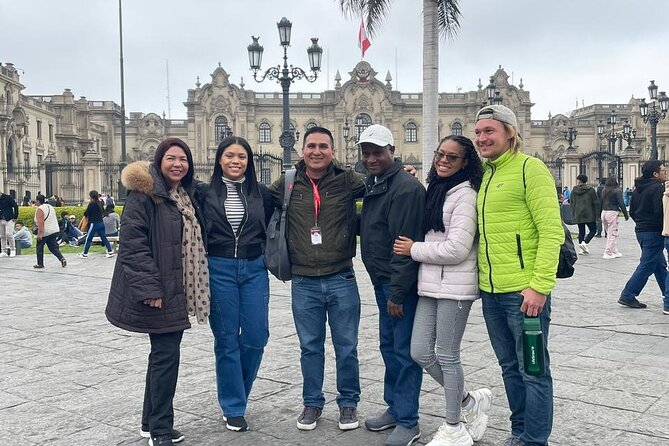
If Lima had a front page, Plaza de Armas, also called Plaza Mayor, would be the headline. The plaza is framed as the historic heart of Lima, founded by Francisco Pizarro in 1535. That date matters, because it ties this location to the city’s founding story.
From here, you also get the big surrounding power structures. The Government Palace, Lima Cathedral, and the Municipal Palace sit in the orbit of the square. Even if you do not go inside every building, standing in the plaza gives you an instant sense of how the city’s civic and religious authority physically gathered in one place.
Then the tour connects it to Peru’s independence story. It is described as a place where independence was proclaimed in 1821. That shifts the meaning of the square again. This is not only an “old buildings” stop. It is a place where national events were declared, which is why it remains central even today.
A small strategy that helps: take one wide photo from the open center, then take two or three tighter photos of the most prominent surrounding facades. That way you capture both the overall square and the architectural details that make it feel like a living museum.
San Francisco Basilica and Convent: Baroque Style, Colonial Library, and the Catacombs
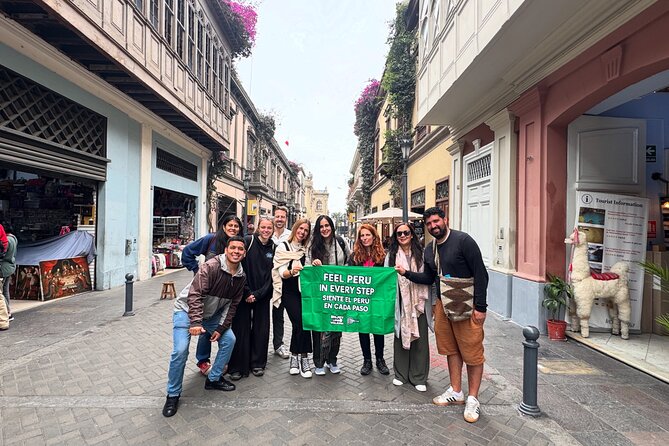
Next comes one of the most dramatic stops in Lima’s historic core: the Basílica and Convent of San Francisco. This is a 17th-century religious complex and one of the major treasures of the Historic Center.
You’re guided toward the Baroque architecture inside the church and convent. Baroque can sound like a style label without meaning, but here it shows up as motion and drama in shape and decoration. If you like churches for more than just photos, this is the stop where Lima’s “religion as art and power” idea becomes concrete.
The description also points to two highlights that many visitors find memorable:
- A colonial library
- Catacombs, used as a cemetery during the viceroyal era
Even if you only get a short look, those references change your understanding. You realize this was not just a place of worship. It also held the physical record of who lived in the city under colonial rule.
This complex is also marked as part of the World Heritage Site, which is useful context when you see the scale and the care in preserving it. It is one thing to visit a pretty church. It is another to visit a preserved complex recognized for its historical value.
Parque de la Muralla by the Rimac: The City’s Protective Wall and Great View Angles
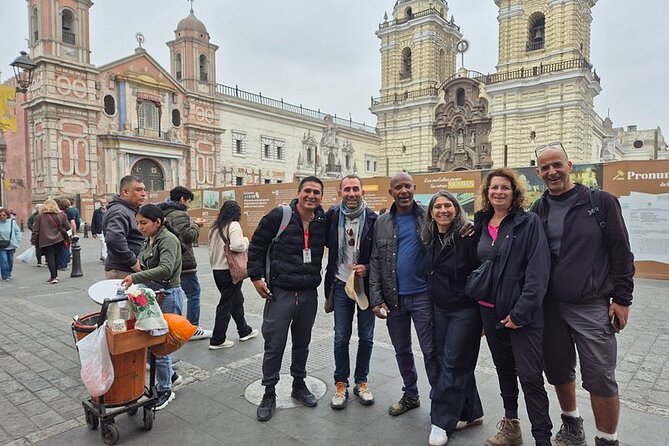
The walk ends with a change of pace at Parque de la Muralla, along the Rimac River. This park preserves remains of the ancient wall that surrounded Lima in the 17th century, built to protect the city from pirates. That detail turns the usual river promenade into something more strategic and defensive.
You will also see it framed as a recreational space today, with gardens and viewpoints, plus a monument to Francisco Pizarro. That is a nice closing note because it brings you back to the founding theme, now seen from a calmer, more open spot rather than the tight center streets.
And if you like a good photo angle, the park offers views of Cerro San Cristobal. It gives you a sense of Lima’s geography at the end of a tour that otherwise stays tightly in the historic core.
Optional Pisco Tasting: Worth It if You Want a Local Finish
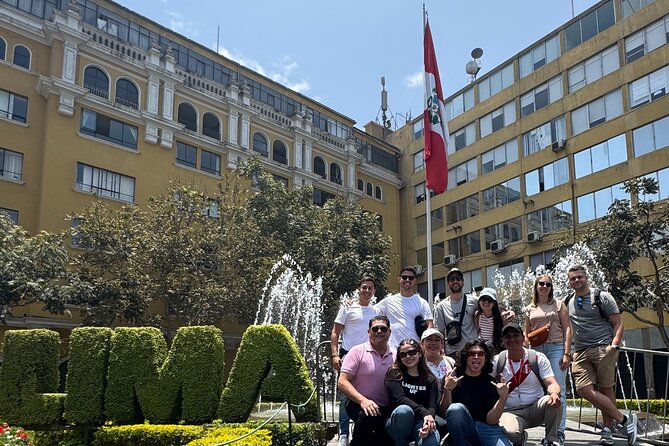
The price includes an official tourism guide, and pisco tasting is optional. If you go for it, it gives you a simple way to connect the trip to something uniquely Peruvian.
Why this matters: a lot of history tours can leave you mentally full but physically empty. A short tasting gives you an easy wrap-up moment. It also works well for groups of friends, because it sparks quick conversation about tastes and impressions.
Of course, if you do not drink alcohol, you might prefer to skip the optional part and keep your energy for photos in the last stretch.
What Makes This Tour Feel Good: Small Group Size and Guide Energy
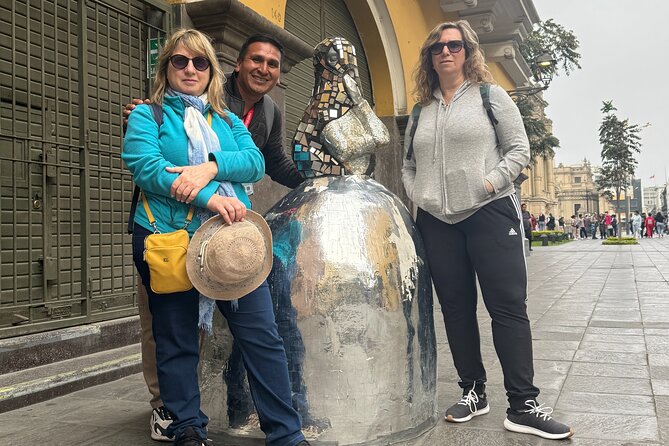
This is one of those Lima tours where the guide makes the difference. In the feedback that matters, names like Gabriel and Alvaro show up for being patient and for packing in stories without making the walk feel like a lecture.
One consistent theme: good guides make room for real questions and for photos. That sounds basic, but it is not automatic in group tours. Here, you also get anecdotes and extra context that helps you connect conquest to the present without losing the thread.
The group size limit of 20 helps. With fewer people, you get a better chance to stay together, ask what you actually want to know, and not just listen to someone talk over the rest of the group.
Timing and Walking Reality: How to Plan a Comfortable Day
The whole experience is about 2 hours, so it fits nicely into a Lima itinerary that already includes museums, food, or neighborhood wandering. Because the stops are short, the pace is steady. You will likely want to schedule this earlier rather than right after you land and need to catch your bearings.
Bring comfortable shoes. You are moving across the Historic Center’s streets, and even on pedestrian sections, the ground can feel uneven or worn. Also, have water on hand, especially if the sun is strong.
The good news: each stop is designed for quick learning, not exhaustion. You get enough time to see the main details and understand what they mean, then you move on before boredom has time to set in.
Value Check: Why $35 Can Be a Good Deal in Lima
At $35 per person, this is priced like a mid-range historic walk. The value comes from a few specific ingredients:
- An official tourism guide
- Major landmarks packed into a tight loop
- Free admission noted for each stop
- Optional pisco tasting
- A small group size cap of 20
If you normally self-tour, the big cost is often your time and your confusion. Hiring a guide for an area like Lima’s Historic Center can be worth it because the guide helps you read what you’re seeing instead of just collecting images.
One more angle: most of the included sights are outdoor-facing or quick-entry stops. That keeps the experience moving while still teaching you enough to make your photos more meaningful.
Still, if you love absolute slow travel and want to spend an hour in just one church, this may feel a bit short. It is built for coverage and clarity, not for wandering alone at your own pace.
Who Should Book This Tour, and Who Might Skip It
This tour is a smart match if you:
- Want a fast orientation to Lima’s Historic Center
- Like architecture and want help noticing details
- Prefer a structured walk with stops that actually teach you something
- Want an optional Peruvian drink wrap-up with pisco tasting
You might skip it if you already know the city well and just want quiet time to explore at your own rhythm. Or if walking for a solid couple of hours sounds like a bad idea for your body that day, you may want a slower option.
Should You Book Enjoy Lima’s Historic Center Walk?
I think you should book it if you want the big Lima storyline in a compact format: independence-era square, the famous connecting street, early church foundations, the political heart at Plaza Mayor, then San Francisco’s convent-and-catacombs atmosphere, capped by views at Parque de la Muralla.
It is also a strong pick for first-time visitors because it helps you get your bearings fast. You leave with a mental map of how the streets connect to power, religion, and national identity.
Just do yourself a favor and wear good shoes, because even a well-paced tour still asks your legs to do their share.
FAQ
How long is the Lima Historic Center walking tour?
The tour runs for about 2 hours.
What is the price per person?
The price is $35.00 per person.
Where do I meet for the tour, and where does it end?
You start at Gran Hotel Bolívar Lima on Jirón de la Unión 958. The tour ends at Muninet Parque La Muralla on Jirón Amazonas, about two blocks from Plaza Mayor.
Is admission included for the stops?
Admission tickets are listed as free for the stops included in the tour.
Is pisco tasting included?
Pisco tasting is optional. It is not described as mandatory.
What size group is the tour limited to?
The maximum group size is 20 travelers.
Is this tour near public transportation?
Yes, it is described as being near public transportation.
Do I need to tip or pay extra at the end?
Tips are not included. The tour also notes that revenue for payment locations and purchases or additional items are not included.
What is the cancellation policy?
You can cancel for free up to 24 hours in advance for a full refund.
Recently reviewed around Lima
- Lunch Menu at Mangos Larcomar restaurant★ 4.0 · 8 reviews
- Sanctuaries of Lima Private Half-Day Tour★ 4.0 · 8 reviews
- Peru Magistral Lima Paracas Ica Cusco Machu Picchu 8 Days★ 5.0 · 8 reviews
- Excursion to Paracas: Huacachina and the Nazca Lines During 2D/1N from Lima★ 4.5 · 8 reviews
- The Larco Museum Complete Guided Tour with Tranfers (Small Group)★ 5.0 · 8 reviews
- Lima Districts: Miraflores, Barranco and San Isidro★ 5.0 · 8 reviews
- Private Transfer from Lima Airport to Miraflores★ 5.0 · 8 reviews
- Panoramic Tour the Best of the City in a Single Tour★ 5.0 · 8 reviews
Walking Tours, compared.
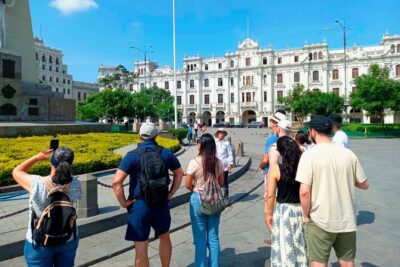
Lima Half-Day City Walking Tour (Small Groups)
Read our review →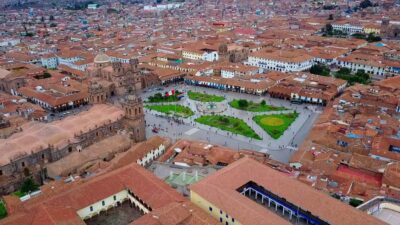
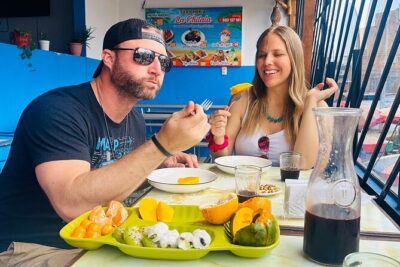
Food & Art: Lima Colors and Flavors Walking Tour
Read our review →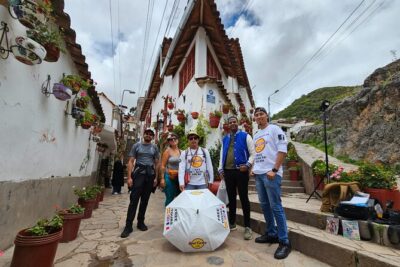
Historic Walking Tour with Pisco Sour and Local Music
Read our review →
Walking tour in the Historic Center of Arequipa
Read our review →
Curious Monkey Cusco- Eat the Streets, Walking Food Tour
Read our review →

Miraflores Trending Flavors Half-Day Walking Tour
Read our review →Browse the lists this tour appears in