
Reviewed · CITY TOURS
City Tour in the city of Cusco 1/2 Day
A Cusco half-day loop through the Inca heartland is interesting because you cover major sites with very different roles, from sun worship at Qorikancha to fortress building at Sacsayhuaman. I like that the day is built for momentum, hitting five big stops with a guide who explains in both English and Spanish. One possible drawback to plan around: entrance tickets are not included, and the schedule can feel rushed when the guide is switching languages at each site.
You start at Plaza Regocijo at 9:00 am, with hotel pickup and group transport. The tour runs about 5 hours 30 minutes, with roughly 40 to 50 minutes per stop, which is usually enough time to read the vibe, spot key details, and move on before you feel totally cooked.
Key highlights at a glance
- Five major Inca-era sites in one compact day, not just one or two.
- Bilingual guiding (English and Spanish) to help you connect history to what you’re seeing.
- Small-group feel with a maximum of 18 travelers.
- Professional, enthusiastic storytelling that focuses on what each place did and why it mattered.
- A practical city-center start with pickup from your hotel.
- A realistic ticket heads-up since you’ll need to buy admission for the stops.
Why this 1/2-day Cusco circuit makes sense
Cusco has a way of making you think you can see everything at once. This tour is a smart antidote. It strings together five sites around town that each represent a different side of Inca life: religion, military power, ritual practice, defense, and water worship. You get variety without having to plan routes, timings, or logistics on your own.
I also like the rhythm. You are not stuck at one place for hours. Instead you get a short, guided hit at each location, then you can decide how long you want to linger. That matters in Cusco, where the streets and crowd flow can turn a calm plan into a shuffle.
The value angle is simple. For around $23.81 per person, you’re paying mostly for transportation plus a guide who connects the dots. If you were trying to arrange a similar loop independently, it would likely cost you more in time and coordination.
More City Tours in Cusco
- Cusco: Half-Day City Tour with Sacsayhuaman and Q’enco
★ 4.6 · 1,129 reviews - City Tour Cusco Qoricancha Sacsayhuaman y Tambomachay
★ 4.7 · 617 reviews - Cusco City Tour Four Ruins in Half-Day
★ 5.0 · 530 reviews
Price and logistics: what you should budget for
The headline price is $23.81 per person, and it typically books about a month in advance. Included are tourist transport, professional guide in English and Spanish, group transport, and pickup from the hotel. The tour also caps out at 18 people, so you should not feel lost in a huge crowd.
What is not included is the big one: entrance tickets for the places you visit. One key practical warning from people who did this is that you should expect to buy tickets at multiple stops, and the total can land around 90 soles (depending on what you purchase that day). If you show up expecting the guide to hand you everything, you’ll be surprised.
Also, lunch is not included. That is fine if you plan your timing, but it means you should eat beforehand or be ready to grab something after. Finally, keep in mind that some stops can be packed, especially Qorikancha, so bring patience and plan to focus on details rather than expecting quiet viewing.
Where you meet and how the group actually moves
You meet at Plaza Regocijo and the tour ends back there. Start time is 9:00 am. This is the kind of classic Cusco pickup that feels easy when it works and chaotic when it doesn’t.
One thing you can do to make it smoother: arrive a few minutes early and be ready to spot your group. People noted that the meeting scene can get messy because multiple tour companies are calling out names by the fountain area. So don’t count on the perfect signage. Have your confirmation details handy and stay near the meeting point until you see your guide or group.
Once you’re together, transport keeps you from spending the whole day navigating. The upside of a group tour is predictability, and this one is built around a clear sequence of five sites. The downside is you have less control over pace. If you want slow, deep wandering with zero rush, this style may feel tight.
Stop 1: Qorikancha, sun-temple layers and that crowded feeling
Qorikancha (the Golden Court) was the most important site dedicated to the sun god. The big story here is layered building: the original sacred complex is gone, but the religious significance remains visible in how later structures were built on top of it. The walls were once covered with gold sheets, and today you’ll see polished stonework and the convent that still uses the Qorikancha name.
What makes this stop worth your attention is the contrast of styles. You’ll spot a Renaissance-style cover and a unique Baroque tower, plus an impressive collection of paintings from the Cusco school. Those details help you understand that this site was not just religious, it was also a symbol of prestige and power across eras.
The practical drawback: Qorikancha can get packed with multiple groups and different guides. You may find it harder to focus on your own. If that happens, shift your strategy. Look for the stonework edges, the architectural transitions, and the painting context, rather than trying to see everything in a single glance.
A few more Cusco days worth comparing
- Classic Inca Trail Trek 4D/3N to Machu Picchu (Group Service)
★ 5.0 · 8,653 reviews - Cusco: Rainbow Mountain and Red Valley Day Trip with Meals
★ 4.9 · 4,893 reviews - Machu Picchu: 4-Day Inca Trail Trek with Panoramic Train Ride
★ 5.0 · 4,568 reviews - Salkantay Classic Trek 5 Days from Cusco
★ 5.0 · 4,062 reviews
Stop 2: Sacsayhuaman, granite force and Inca military design
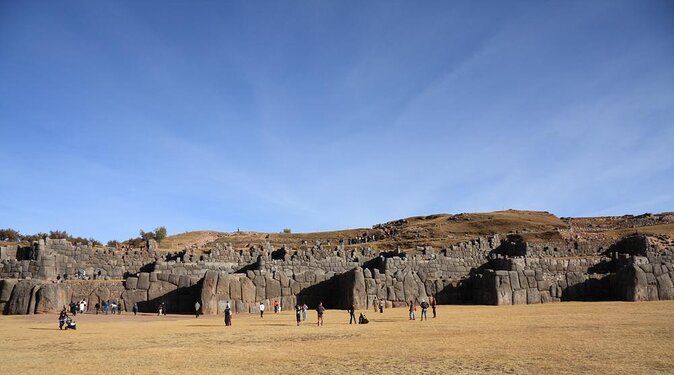
Sacsayhuaman is the fortress that protected Cusco. Even if you don’t know Quechua, the name gives a hint that this was a major stronghold. Here, you’re looking at Inca military architecture built for defense, not just ceremony.
The scale is the wow factor. The fortress uses huge granite blocks, some reaching up to 5 meters high and weighing as much as 350 tons. That’s not background noise. It’s the point. The site is arranged in three large terraces, bordered by colossal stone walls that stretch up to 300 meters long.
Another detail that helps you connect past and present: because of its proximity to Cusco, Sacsayhuaman also served as a quarry for some colonial constructions. So when you see the fortress, you can also imagine how its materials echoed into later building.
The tour gives you about 1 hour here, which is a realistic amount to walk the key angles. If the group is moving quickly, you’ll still get enough time to grasp the terraces and the wall system without feeling like you missed the main game.
Stop 3: Q’enqo, carved ritual spaces and the chicha clue
Q’enqo was an Inca ceremonial center, used for rituals and ceremonies with tunnels and platforms. This is one of the stops where you’ll benefit most from a guide who explains what you’re looking at, because the purpose is not always obvious from the first glance.
What stands out are the carvings: holes, steps, and channels. The best clue we have for how this space worked is that it was probably used to deposit chicha, a corn-based drink, during Inca rituals. It is a small detail, but it changes how you see the whole site. You stop thinking only about stone shapes and start thinking about how people used the area as part of a ritual process.
You get about 40 minutes at Q’enqo, which is tight but fair. It gives you time to understand the layout and the carvings, then move on. If you’re the type who reads every plaque, you may wish you had more time, but for most people the short guided version is the right balance.
Stop 4: Puka Pukara, the red fortress and water-smart defense
Puka Pukara is also known as the red fortress because the stones have turned a reddish color, thanks to iron in the rock. That color is not just aesthetic. It makes the site visually distinct from the surrounding ruins, which helps your brain keep track as you hop between locations.
Along with the fortress, you’ll see other archaeological features like aqueducts, enclosures, and fountains. It also matters that Puka Pukara is close to Tambomachay, and it is believed to have been part of the military defense of that area. In other words, it’s not only about surviving raids. It’s about protecting a strategic zone that also had water and ceremonial meaning nearby.
The tour spends about 40 minutes here. That time is usually enough to walk the key shapes, notice how the stone fortress is set up, and connect it to the idea of defense near a water and ceremony area.
Stop 5: Tambomachay, the Inca Bath and carved water channels
Tambomachay is known as the Inca Bath. This stop centers on water worship and ceremony, tied to springs, carved rock, channels, and waterfalls. You’ll see the site built from carved rocks that shape a system of channels. The water comes from springs, which is why the place feels like it was designed to keep water in motion.
There’s also a political layer. Tambomachay is described as a resting place of the Inca monarch, so it wasn’t just practical water management. It carried ceremonial status and meaning.
The tour gives you about 50 minutes, which works well here because the water features are easier to appreciate when you have a little time to slow down. Even if your group is moving, this is the stop where you can usually find a moment to step back and watch the channels and flow.
Guides, pace, and how to get more out of the day
The best thing about this tour is often the guide. People praised professional, enthusiastic explanation and story-led context that makes each site feel connected. In at least some cases, the guide name Bladimir comes up for very strong historical storytelling and clear answers to questions.
Still, there’s a realistic caveat. One downside you may run into is pacing and language flow. If you’re an English-only speaker, you might feel the tour is rushed at some stops when the guide explains in two languages at each location. That doesn’t mean the content is bad. It just means you should mentally plan for less breathing room if the group is bilingual.
If Qorikancha is packed, don’t let that steal your attention. Focus on one or two things: stonework transitions, the Renaissance and Baroque elements, or the Cusco school paintings.
Also, bring your own water. One person noted that a water bottle was expected but not delivered. The tour doesn’t list water as included, so it is safer to have your own.
Finally, think of this as your orientation day. If you do it early in your Cusco stay, you’ll understand the city’s Inca landscape faster when you explore on your own later.
Should you book this Cusco city tour?
Book it if you want a time-efficient Cusco overview that hits the major Inca-era sites around town, with guided explanations and included transportation plus hotel pickup. It’s also a good pick for first-timers who want to understand what each site represents without spending hours planning.
Skip or reconsider if you are allergic to ticket lines and extra costs. Since entrance admissions are not included and you may need multiple tickets for the stops, factor that into your total budget. Also reconsider if you strongly prefer one-language guiding and a slower pace. Some people found the bilingual format made the tour feel rushed.
If your goal is to leave with a clear sense of Cusco’s Inca story, this tour is a solid way to get there in a half day.
FAQ
What is the duration of the Cusco city tour?
It runs about 5 hours 30 minutes (approx.).
What time does the tour start, and where does it meet?
It starts at 9:00 am and the meeting point is Plaza Regocijo in Cusco.
Is hotel pickup included?
Yes. Pickup from your hotel is included.
Are entrance tickets included for the sites?
No. Entrance tickets for the places to visit are not included.
What languages does the guide speak?
The guide provides explanations in English and Spanish.
How many people are in the group?
The tour has a maximum of 18 travelers.
What is the cancellation policy?
Free cancellation is available. You can cancel up to 24 hours in advance for a full refund.
Recently reviewed around Cusco
- Cusco Cooking Class by ChocoMuseo in Cusco★ 5.0 · 29 reviews
- ATV Adventure to Moray and Maras Salt Mines – Half Day★ 4.5 · 29 reviews
- 1-day excursion to Machu Picchu from Cusco★ 5.0 · 29 reviews
- Private Tour Sacred Valley, Chinchero, Maras Moray, Ollantaytambo★ 5.0 · 29 reviews
- From Cusco: Humantay Lake with Breakfast and Buffet Lunch★ 4.5 · 29 reviews
- 4 Day – Inca Jungle to Machu Picchu★ 5.0 · 29 reviews
- 2-Day Machu Picchu Tour by Train from Cusco★ 4.5 · 29 reviews
- 2-Day Sacred Valley and Machu Picchu Tour By Train★ 4.5 · 29 reviews
City Tours, compared.
Lima Half-Day City Walking Tour (Small Groups)
Read our review →
Half-Day City Tour with Sacsayhuaman and Q’enco
Read our review →
City Tour Panoramic Bus Departure From Larcomar
Read our review →
City Tour Cusco Qoricancha Sacsayhuaman y Tambomachay
Read our review →
Lima’s lively Heritage: Exploring the City’s Landmarks Half-day
Read our review →
Sightseeing Tour of the City on an Open-Top Bus
Read our review →
Lima City, Central Market & Catacombs Tour (Pick-up & Drop Off)
Read our review →Browse the lists this tour appears in