

Reviewed · CITY TOURS
City Tour Panoramic Bus Departure From Larcomar
This Lima trip is interesting because you get Miraflores cliff views first, then you shift gears into Lima’s power-and-church historic center in the same half day. It is a practical way to understand where Lima sits and how it grew, without planning your own route block by block.
Two things I really like are the built-in pacing and the guide-led structure. You start at the sea-level promenade area around Larcomar, then you move into the older parts of downtown where a good guide helps you connect buildings, names, and dates.
One drawback to keep in mind: Lima traffic can eat into your time on the bus, and your walking portion may feel warmer and tighter depending on the day. If crowds or demonstrations affect the historic center, you should be ready to follow the guide’s adjustments.
Key highlights you’ll feel right away
- Larcomar’s cliff-top setting gives you an instant “this is Lima” view
- Official guided walking in the Historic Center helps you read the city instead of just passing it
- Museo Santo Domingo is included with an actual guided visit, not just free entry
- Miraflores icons in one sweep, from Kennedy Park to the pre Inka ceremonial center area
- Four hours works well for first-timers, especially if it is your first day in town
- Small group limit of 40 keeps the tour more manageable than huge bus groups
Why this Larcomar to Central Lima tour is a smart intro
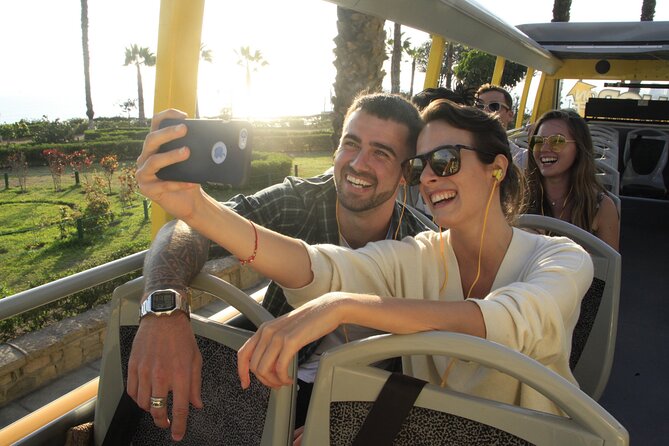
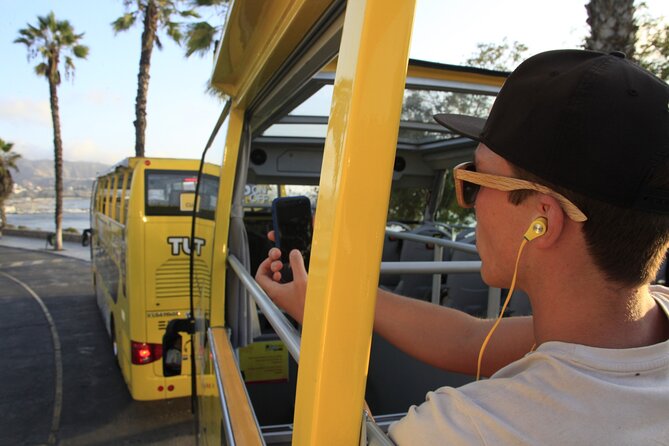
This tour is built for orientation. You ride a panoramic bus through key areas, then you do a guided walk in central Lima where the details matter. If you want to understand how Miraflores connects to the old city, this format is efficient.
The value is not just the sights. It is also the structure: you get an official guide in the historic center, plus an included museum stop. That combination tends to turn a scenic ride into something you can actually remember.
I also like that the tour includes everyday comfort touches on the bus. WiFi and USB phone chargers are listed, which is handy when you are juggling maps, photos, and translation.
More City Tours in Lima
- Lima Half-Day City Walking Tour (Small Groups)
★ 5.0 · 1,508 reviews - Lima’s lively Heritage: Exploring the City’s Landmarks Half-day
★ 4.5 · 581 reviews - Lima City, Central Market & Catacombs Tour (Pick-up & Drop Off)
★ 5.0 · 228 reviews
Starting at Malecón de la Reserva: Larcomar’s cliffside “floating” feeling
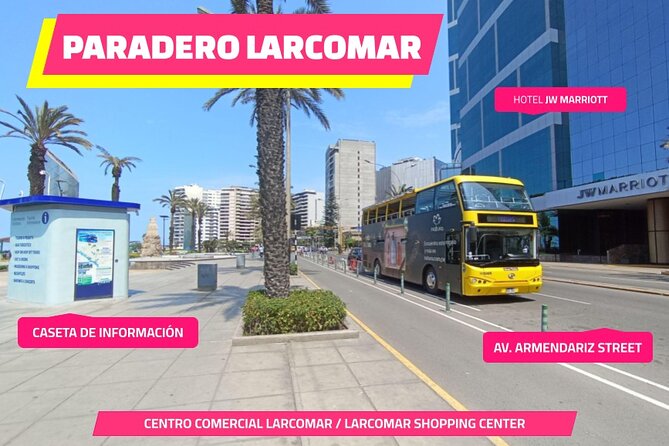
You begin around Larcomar, a shopping and entertainment complex built on a cliff excavation. The design creates a floating feel, since many spaces sit out over the void. For photos and first impressions, that unusual construction is half the point.
What you should watch for is the way the area blends architecture with engineering. The underground ventilation system uses large exhaust chimneys, which show up in the park as large bluish glass sculptures. Even if you do not focus on design, these pieces give you a sense of how the site was made workable.
Larcomar also makes sense as a departure point. It is in Miraflores, near hotels, and it draws big numbers of foreign tourists each month. In practical terms, that means the pickup flow is usually smoother than leaving from a random street corner.
Miraflores stops that set the tone: pre Inka center and the fountains
After you leave Larcomar, the tour moves through Miraflores highlights that show Lima is not just colonial churches and plazas. One stop is the magnificent pre Inka ceremonial center located in Miraflores. The tour framing here matters, because it reminds you Lima layers time periods on top of each other.
Then you have the park of cybernetic water fountains, known for a Guinness record tied to the highest fountain jet in the world. This is the kind of stop that breaks up the academic pace with a visual show. Even if you do not stay long, it gives your eyes something to track besides buildings.
Miraflores is often treated like a modern beach neighborhood, and it is. But these stops keep the trip from feeling like a single era. You get that “Lima is layered” feeling early, before the route enters downtown.
The Palacio style stop: neocolonial building details to notice
Another key pause is the building designed by Peruvian architect Luis Miró Quesada Garland. It was inaugurated on July 28, 1944, replacing an earlier headquarters located in a mansion at the intersection of Bellavista and José Gálvez avenues.
Architecturally, it is neocolonial in style, built with brick and reinforced concrete. Two details are called out in the tour description: a corner tower and the facade. If you take one minute to look up at those features, you will understand why people photograph it.
Inside, the town hall and a rotunda on the second floor are part of the story, including murals by painter Teodoro Nuñez Ureta. You may not have time for a deep interior tour, but even an exterior or lobby look gives you context for why Miraflores feels both coastal and ceremonial.
A few more Lima days worth comparing
- Premium Paracas & Huacachina Day Trip from Lima with Sunset Toast
★ 5.0 · 7,380 reviews - Full Day Tour From Lima: Paracas and Huacachina Oasis
★ 5.0 · 3,694 reviews - Lima Ultimate Peruvian Food Tour
★ 5.0 · 1,845 reviews - Paracas and Huacachina Exclusive Sunset Picnic Tour
★ 5.0 · 1,398 reviews
Parque Kennedy and Parque 7 de Junio: why this park is worth the photos
The Central Park of Miraflores, popularly known as Parque Kennedy (and tied to Parque 7 de Junio), is one of the most visited parks in Lima. It is made up of two parks next to each other, totaling about 22,000 square meters.
For me, parks like this are where a city’s personality becomes visible. This is where you see everyday life: meeting points, casual strolling, and people watching. On a tour day, it also works as a reset between bus time and walking time.
If you like street-level atmosphere, you will appreciate that the tour includes this stop rather than skipping straight into downtown monuments. It gives you a “real neighborhood” layer.
From Miraflores toward downtown: Eiffel’s building and the Italian Art Museum
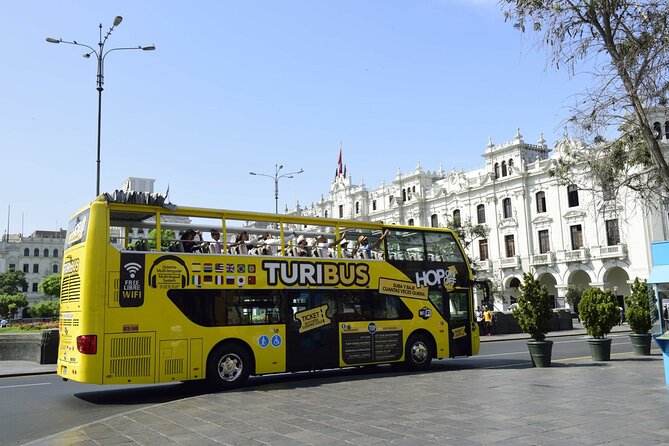
As the bus shifts toward central Lima, you pass into areas tied to culture and museums. The tour includes an 18th century building designed by Gustave Eiffel, plus a stop connected to art and history.
You also have the Museum of Italian Art, in a Neo-Renaissance style building. The museum houses bronze and marble sculptures, paintings, and ceramics by more than 120 Italian artists from the early 20th century. The tour notes it is the only European art museum in the country.
Even if you are not an art devotee, this helps you understand the Lima of the early 1900s, when European influence in architecture and collections was strong. It also adds a “brain break” from churches and governmental buildings once you enter the historic center area.
Parque de la Exposición, Plaza Grau, and named squares you can actually place
The route includes Parque de la Exposición, a park in the center of Lima that was inaugurated in 1872. It is bounded by major avenues, including Paseo Colón and 28 de Julio. Within the park area, the tour description lists multiple cultural institutions, including the Museum of Art of Lima in the Palace of the Exhibition.
The park was declared Cultural Patrimony of the Nation in 2006. That detail matters because it signals you are not just passing a green patch, you are moving through a protected cultural zone.
Next you reach Plaza Grau, a square in central Lima named for Miguel Grau Seminario, commander of the Huáscar monitor during the Pacific War. After that, the tour includes the Paseo de los Héroes Navales, which occupies the first block of Paseo de la República and was named on October 8, 1979 to commemorate the centenary of the Angamos combat.
Why does this matter for you? Because these names show how Lima preserves national stories in plain public space. When you later see the older colonial center, it feels connected, not random.
Entering the Historic Center: Plaza San Martín and Jirón de la Unión
Once the tour gets into the historic core, you get the classic Lima framing. You start at Plaza San Martín, an area within Avenida Nicolás de Piérola in the historic center. It was declared a World Heritage Site by UNESCO in 1988.
Then comes Jirón de la Unión, the street on the Damero de Pizarro. Historically it was the most important street in the city, described as the most aristocratic where famous inhabitants met. Even if you are just looking for quick photos and a sense of scale, this street helps you feel the city’s old social gravity.
These are short stops by design. The practical goal is to place the bigger monuments into a street grid you can later recognize on your own.
Plaza Mayor and the Cathedral area: where Lima’s story turns into real buildings
The tour’s walking portion includes Plaza de Armas (Plaza Mayor). This is the founding site of Lima, and it sits surrounded by major institutions like the Government Palace and the Cathedral of Lima. You will also see other churches and palaces around the square, plus the street intersections that cross it.
The Cathedral of Lima is built on a site connected to Inca-era history. The tour description notes it was placed over an Inca shrine tied to the puma inti concept, and a Cusco prince Sinchi Puma’s palace area. When Lima was founded, Francisco Pizarro assigned land to the church, leading Sinchi Puma to renounce his assets on paper to avoid usurpation.
If you want a simple way to make sense of this: the cathedral is not just a religious building. It is a historical marker that shows how the new order was imposed on earlier sacred space.
The Government Palace of Peru: Casa de Pizarro and the long chain of power
Right near the Plaza Mayor, you also get time at the Government Palace of Peru, sometimes called Casa de Pizarro. It is described as the main seat of the Peruvian executive branch and the official residence of the President of Peru.
The tour notes that the location has functioned for the same kind of political purpose for nearly five centuries, since 1535. Before it was the viceroyal palace during the Spanish period, it served as the residence of the curaca Taulichusco, and later it was home to figures like José de San Martín and Simón Bolívar.
Even when you cannot go inside, understanding the building’s continuity changes how you look at it. A facade becomes a timeline.
Museo Santo Domingo: the included museum stop that anchors the end of the day
The tour includes an entrance ticket to Museo Santo Domingo, plus guided service during the museum visit. The time listed for this museum stop is 25 minutes, so it is not a long, sit-and-read afternoon.
Still, this is the part that often makes short city tours feel worth it. A museum visit gives your brain somewhere to store what you just saw in the streets, and the guide helps you connect cultural dots instead of just letting you walk through rooms.
The tour description frames the central museum space as using dialogue through art to recognize cultural tradition over thousands of years, enriched and transformed over time. Even with limited time, a guided visit helps you slow down and notice what is there.
If you are the kind of person who wants one or two real stops, not only photos, this museum inclusion is a strong reason to choose the tour.
Timing and logistics: how to handle Lima traffic and walking heat
This is about a 4-hour experience, give or take. That means the bus ride counts. If you get stuck in city traffic, your sightseeing can feel compressed.
You can plan for this. Bring water, wear comfortable shoes, and use sun protection. One review line mentions a hot walk, even when the tour is otherwise manageable.
The walking pace can also vary with the group and the guide. One account describes a guide being quick and some guests struggling to keep up. If you prefer a slower pace, you will do best by speaking up early and staying close to the guide during key photo moments.
Also, the historic center can be affected by crowds and demonstrations. One experience described route changes and people walking away from the bus for blocks due to a protest. You cannot control that, but you can control your reaction: stay calm, follow the guide’s instructions, and prioritize your safety over grabbing the perfect photo.
Price and value: what you get for about $35
At $35 per person, this tour stacks several paid items into one package. Included are all fees and taxes, entrance ticket to the panoramic bus, and a guided service in the historic center with an official tour guide.
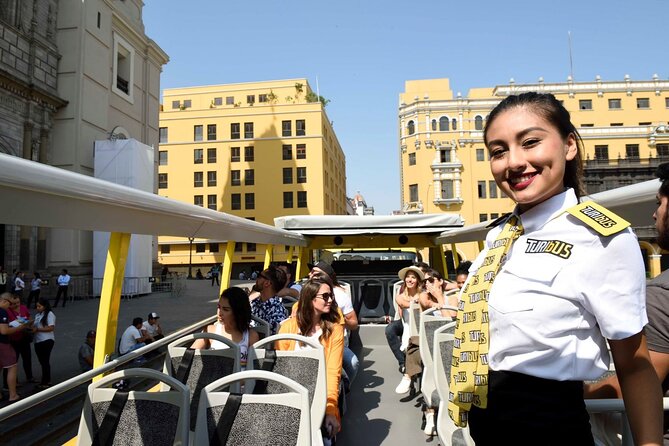
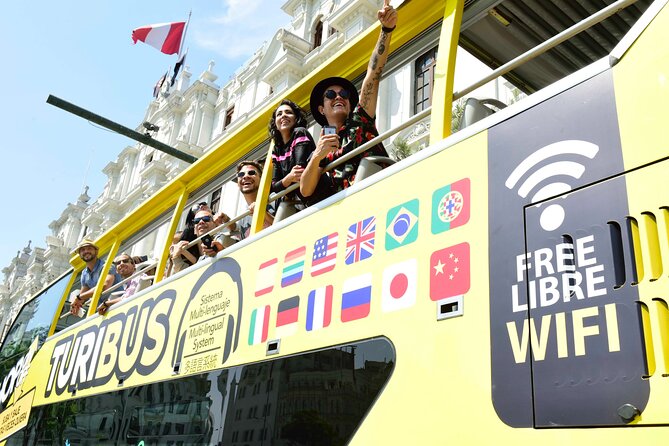
You also get WiFi on board and USB chargers. Those are small details, but on a city day they reduce the hassle cost of charging and navigation.
The biggest value lever is the museum. Entrance and guided service at Museo Santo Domingo are included. If you have ever tried to tack on a museum visit on your own in a tight schedule, you know how quickly time and coordination slip away.
Not included: tips for guides and drivers, plus income to attractions not indicated. Plan a little extra for souvenirs during photo stops, especially around areas where you will be offered quick shopping chances.
Guides and group size: up to 40, usually bilingual
The group limit is 40 travelers. A group this size is large enough to be lively but small enough for a guide to manage directions in a crowded historic core.
Language is supported in both English and Spanish, based on accounts from the tour. Guide names you may meet include Marisa, Joseline, Elizabeth, Edwin, and Melisa. Each guide can change your experience, but the common thread is that strong guides help you slow down and understand what you are seeing.
One review also highlights patience with elderly parents and a pace that worked for limited mobility within the walking portion. That is not a guarantee for every departure, but it is a good sign: the tour can be flexible when the guide chooses to be.
Who should book, and who should think twice
Book this tour if you want a clean first day overview of Lima that mixes modern Miraflores stops with downtown landmarks. It is a good fit for history-minded people who also want real comfort, WiFi, and a guided museum stop.
Families can like it because the bus covers distance fast, and the walking portion is guided. If you have mobility needs, you should still plan on some walking, but the format can work better than a strictly walking tour.
Think twice if you are expecting a true hop-on hop-off setup. One review describes it as not being that kind of flexible ride, with time mainly concentrated at a specific historic center stop and a guided walk there. If you want to wander freely for hours on your own terms, this is probably not the best match.
Also, if you hate traffic delays, this format can feel like wasted time. You may still enjoy the bus narration, but city congestion can still limit how much you can do.
Should you book this Larcomar to Historic Center tour?
Yes, if you want a high-efficiency Lima orientation with official guiding and an included Museo Santo Domingo stop. The Miraflores start at Larcomar is a strong visual entry, and the historic center walking portion gives you the context that makes the Plaza Mayor area click.
I would book it for your first or second day in Lima, especially if your schedule is tight. If you are traveling during major holidays or weekends, go in with patience for crowds and traffic, and stay flexible if the route in the historic center changes.
FAQ
How long is the Lima City Tour Panoramic Bus Departure From Larcomar?
The tour lasts about 4 hours.
How much does the tour cost?
It costs $35.00 per person.
Where do I meet for the tour?
The start meeting point is Mal. de la Reserva 616, Miraflores 15074, Peru.
Where do I redeem the ticket?
The ticket redemption point is Turibus, Larcomar, Mal. de la Reserva 610, Miraflores 15074, Peru.
What is included in the price?
The tour includes all fees and taxes, WiFi on board, USB chargers, a guided service during the historic center walking tour with an official tour guide, the entrance ticket to the panoramic bus, and entrance plus guided service for the Museum of Santo Domingo.
Is this a hop-on hop-off bus tour?
The information provided and the experiences described indicate it is not set up as a hop-on hop-off style tour.
How big is the group?
The maximum group size is 40 travelers.
Can I cancel for a full refund?
Yes. Free cancellation is offered up to 24 hours in advance for a full refund. If you cancel less than 24 hours before the start time, the amount paid is not refunded.
Recently reviewed around Lima
- Lima Highlights! – City Tour & Miraflores, Barranco & San Isidro★ 5.0 · 29 reviews
- Lima Surf Trip★ 5.0 · 29 reviews
- Modern and Colonial Lima City Tour.★ 4.5 · 29 reviews
- Full day Tour Paracas Ica & Huacachina from Lima.★ 5.0 · 29 reviews
- Bohemian and artistic ravine walking tour★ 5.0 · 29 reviews
- Discover Barranco’s Nightlife with Bar Crawl Lima★ 5.0 · 29 reviews
- Cooking Class + Market Tour + City Walking Tour (Full Day).★ 5.0 · 30 reviews
- Machu Picchu, Cusco & Lima 7-Day Tour★ 5.0 · 30 reviews
City Tours, compared.
Lima Half-Day City Walking Tour (Small Groups)
Read our review →
Half-Day City Tour with Sacsayhuaman and Q’enco
Read our review →
City Tour Cusco Qoricancha Sacsayhuaman y Tambomachay
Read our review →
Lima’s lively Heritage: Exploring the City’s Landmarks Half-day
Read our review →
Sightseeing Tour of the City on an Open-Top Bus
Read our review →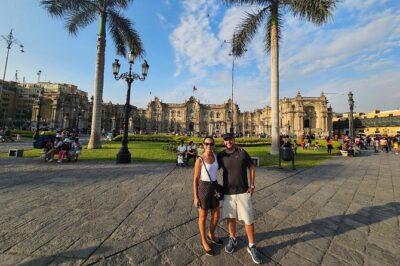
Lima City, Central Market & Catacombs Tour (Pick-up & Drop Off)
Read our review →
Browse the lists this tour appears in